Every morning, before I publish one of these, I run my writing through a list. Not spellcheck. A keyword list or list of BIP ideas that I've logged in a memory file to give me content ideas when I'm down on energy or need new material. I want to avoid a list of the words and phrases AI reaches for when it has nothing to say, the tells that make a paragraph read like every other paragraph on the internet. I have been building that list for months, and running the cull is the last thing I do before I publish.
This week I finally saw a picture of why that work matters, and why AI writing reads as slop. Someone had run human writing and five different AI models through a rarity score, roughly how unusual a piece of writing is against everything the model has already seen, and plotted them next to each other. Human writing spread across the whole range, from ordinary all the way up to genuinely rare. Every model, GPT, Claude, Gemini, the lot, bunched into a fat band around the middle. Average, by construction. That band is the thing we have started calling slop, but visually seen, it changes the picture (pun!).
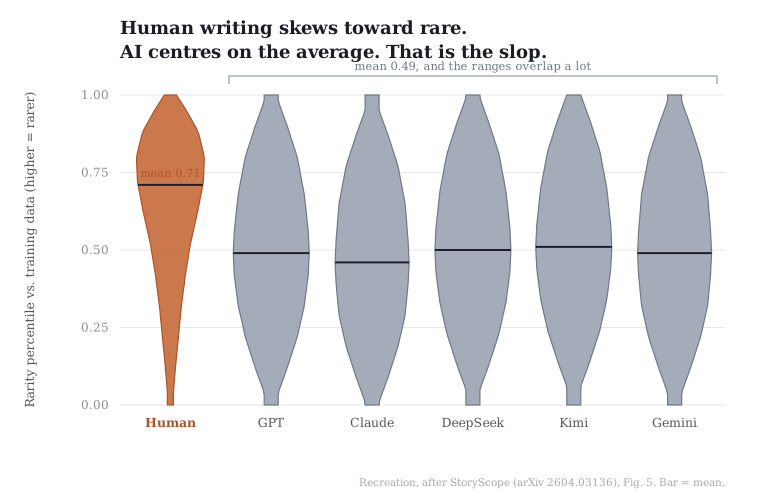
It is not that the models write badly. They write competently every time, which is the actual problem. Ask a thousand people to describe a morning and a few of them will say something you have never heard before. Ask a model and it gives you the most probable next word, again and again, the exact middle of the distribution. Competent and forgettable is the factory setting.
Which is why I am not worried about AI and how I use it even though I'm in it eight to nine hours per day. Used well it is an amplifier, not a replacement. The value was never in just letting it run wild, being lazy and not doing the actual creative human experience part of the writing. AI doesn't have experiences, we do. This is the part the model cannot do on its own: asking the question after the question, noticing the blind spot nobody flagged, challenging the output, deciding what the data actually means and whether the story is even true. Point your own mind at it and it makes you faster and sharper. Hand it your thinking and it hands you back the middle of the distribution, which is exactly why when you read AI slop you know exactly where it came from, and why it reads like garbage. I've been guilty of it myself, but I do try and point the agent at topics that are unique to me and my situation.
This holds for numbers as much as words. A model will give you a clean chart and a tidy summary in seconds. The "so what," the insight someone will actually pay for, the blind spot nobody thought to check, still comes from a person who can explain it. It is the same reason I keep a banned-words list for my own writing. The writing has to sound like a person actually lived it, and ideally wrote about it. Even if it's co-authored by an agent.
It is why I keep doing the hard version. The cull every morning. The question after the question. Refusing to publish the most average answer just because it is ready and it reads fine. Because the things that cannot be faked become the whole game. Slop is cheap. Real is rare. And rare is what people will pay for.
Monthly Revenues $11,000 | Clients 2 | Prospects 1 warm lead | Team: Me with Jan on standby
Day 98 of 365.